Can You Do the Ha Giang Loop on a Scooter? What Travelers Should Know
Learn whether a Ha Giang Loop scooter tour is suitable for you, including scooter limitations, mountain descents, road conditions, licence requirements and Easy Rider alternatives.
A Ha Giang Loop scooter tour may sound appealing if you already feel comfortable riding an automatic scooter. There is no clutch to manage, no manual gear changes and many main sections of the Loop are paved. However, riding a scooter in Ha Giang is very different from using one for short urban trips. Long descents, repeated hairpin bends, changing road surfaces and mountain weather all make bike choice important. At Odyssey, travelers are encouraged to consider riding experience just as carefully as convenience before deciding how to explore the Loop.
Can You Really Do the Ha Giang Loop on a Scooter?
Yes, it is physically possible to complete much of the Ha Giang Loop on an automatic scooter.
The more important question is whether that scooter gives you enough control for:
Your riding experience.
The amount of luggage you carry.
Road conditions.
Weather.
Long mountain descents.
A passenger, if you have one.
A scooter may be able to climb the road, but climbing ability alone does not determine whether it is the right choice.
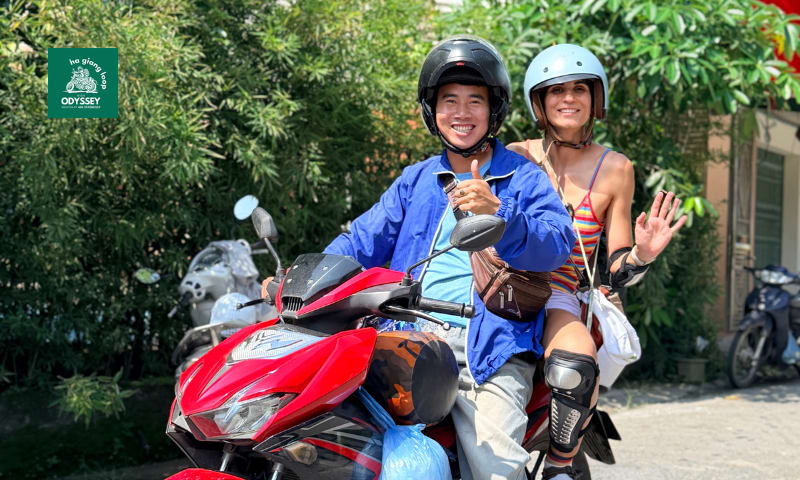
Automatic scooter riding on a mountain road in Ha Giang
Technically Yes — But Possible Does Not Mean Ideal
Automatic scooters are widely used throughout Vietnam.
A scooter with a suitable engine size can handle many paved mountain sections around Ha Giang.
However, paved roads do not necessarily mean easy roads.
You may still encounter:
Steep gradients.
Tight hairpin bends.
Narrow sections.
Gravel.
Roadworks.
Broken road edges.
Potholes.
Livestock.
Trucks and buses.
Wet or muddy surfaces.
The real challenge is controlling the scooter consistently for several hours each day.
Mountain Riding Is Different From City Riding
A traveler who regularly rides scooters in mountainous terrain will approach the Loop very differently from someone whose experience comes mainly from flat city roads.
Urban riding may involve traffic and frequent stops, but mountain riding adds:
Long climbs.
Long descents.
Repeated corners.
Changes in elevation.
Variable traction.
Longer periods of concentration.
This distinction matters more than simply asking whether you know how to operate a scooter.
The Biggest Limitation: Engine Braking on Long Descents
One of the most important differences between an automatic scooter and a geared motorcycle becomes noticeable when traveling downhill.
Most automatic scooters use a continuously variable transmission, or CVT.
This is convenient because the rider mainly controls:
Throttle.
Front brake.
Rear brake.
However, the rider has less direct control over engine braking than on a semi-automatic or manual motorcycle.
Why Engine Braking Matters
On a geared motorcycle, the rider can select a lower gear.
The engine then helps resist the bike's forward motion.
This reduces how much work the wheel brakes need to do during a long descent.
On an automatic scooter, more speed control may depend on the brakes.
Repeated or continuous braking produces heat.
If braking components become excessively hot, braking performance can decrease.
This is one reason long descents deserve as much attention as steep climbs.
Scooter rider approaching steep bends on the Ha Giang Loop
Scooter Riders Should Manage Descents Carefully
When descending:
Control speed before the steep section: Do not wait until the bike has already accelerated.
Brake progressively: Smooth inputs help maintain stability.
Reduce speed before corners: Avoid entering hairpins too quickly.
Avoid continuously dragging the brakes: Extended braking can generate unnecessary heat.
Take breaks when needed: Long descents do not need to be completed without stopping.
Pay attention to changes in braking: If the controls feel noticeably different, stop and assess the situation.
The issue is not that every automatic scooter becomes unsafe on a descent.
The issue is that the rider needs to understand how the bike behaves before committing to long mountain sections.
Steep Climbs Are Only Half the Story
Travelers often ask whether a 110cc or 125cc scooter has enough power for Ha Giang.
Power matters, especially when carrying:
Two people.
Large luggage.
Additional bags.
But being able to climb a mountain is only one part of the riding experience.
Starting on an Incline
If you stop halfway up a steep road, you may need to restart while balancing the scooter and controlling the throttle.
This becomes more difficult with additional weight.
Tight Uphill Hairpins
Momentum matters.
If you slow too much before or during a tight uphill bend, the scooter can become harder to balance.
Meeting Large Vehicles
Narrow roads sometimes require you to:
Slow sharply.
Move toward the edge.
Stop.
Restart on an incline.
This demands more control than simply maintaining speed on an open road.
Carrying a Passenger
A passenger changes:
Acceleration.
Braking distance.
Balance.
Cornering.
Low-speed handling.
A bike that feels easy when ridden alone may feel noticeably different with two people and luggage.
Every Climb Is Followed by a Descent
This is the part many first-time mountain riders underestimate.
A scooter that successfully reaches the top still needs to return downhill under control.
Automatic scooter descending a mountain pass in Ha Giang
Road Conditions Can Change Quickly
The same road can feel very different from one day to another.
A dry section with clear visibility may feel manageable.
The same route in rain or fog can become much more demanding.
Rain
Wet roads reduce grip.
Riders also need to manage:
Braking.
Cornering.
Visibility.
Water on the road.
Mud.
Slippery painted surfaces.
Fog
Fog can dramatically reduce visibility on high passes.
A road you could normally read several bends ahead may suddenly require a much slower pace.
Gravel and Broken Surfaces
Temporary roadworks or damaged sections may create:
Loose gravel.
Rough surfaces.
Potholes.
Broken road edges.
Some scooters use relatively small wheels compared with larger motorcycles.
Small wheels are not automatically unsuitable, but rough surfaces require more attention and smoother inputs.
Conditions Can Change During the Same Day
Do not assume that because the morning roads were dry, the entire day's route will be the same.
Before each riding day, consider current conditions and adjust your expectations accordingly.
Where Scooter Limitations Matter Most
Not every kilometer of the Loop has the same difficulty.
Certain sections make rider skill, transmission type and speed control more noticeable.
Bac Sum and the Road Toward Quan Ba
These early mountain sections introduce:
Sustained climbing.
Repeated bends.
Elevation changes.
For many visitors, this is where they first realize how different Ha Giang feels from ordinary city riding.
Tham Ma Pass
Tham Ma Pass contains repeated tight bends.
The main challenge is not maximum power.
It is controlling your speed and positioning before entering each corner.
Riders also need to remain aware of vehicles coming in the opposite direction.
Dong Van to Meo Vac
This section includes the Ma Pi Leng area.
The route contains:
Dramatic elevation changes.
Narrow mountain roads.
Long descents.
Frequent viewpoints.
Sections requiring sustained concentration.
The scenery is impressive, but self-riders need to keep their attention on the road.
Meo Vac Toward Du Gia
Road surfaces can become less consistent compared with some of the more established highway sections.
This is where slower riding and careful surface reading become especially useful.
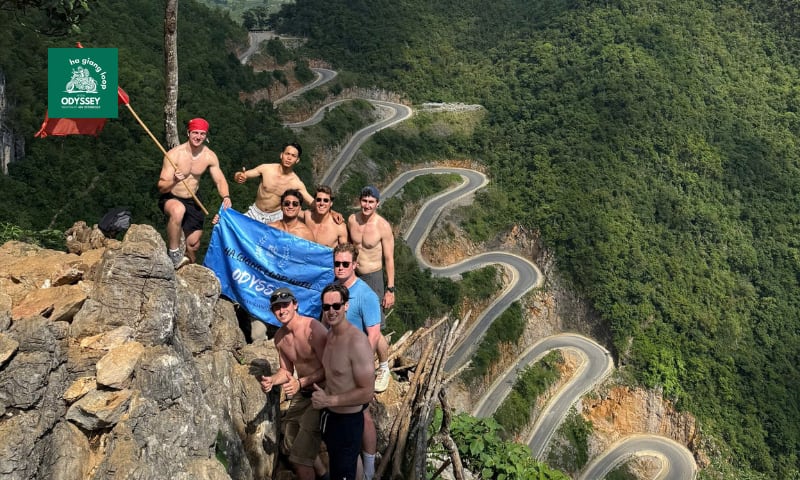
Scooter riding through Ma Pi Leng Pass and changing road conditions
Automatic Scooter vs Semi-Automatic vs Manual Motorcycle
Bike choice should match your actual riding ability.
Automatic Scooter
Advantages include:
Simple controls.
No manual clutch.
No gear selection.
Familiarity for many travelers.
The main limitation is reduced direct gear control, especially on long descents.
Semi-Automatic Motorcycle
A semi-automatic bike gives you gears without requiring a hand-operated clutch.
This allows you to select lower gears for climbs and descents.
For some riders, it provides a useful middle ground between an automatic scooter and a fully manual motorcycle.
However, you still need to understand:
Gear selection.
Braking.
Cornering.
Mountain-road technique.
Do not choose a semi-automatic for the first time immediately before entering demanding mountain roads without proper preparation.
Manual Motorcycle
Manual motorcycles offer the greatest direct control over gearing.
They can be well suited to mountain terrain for riders who already know how to use them confidently.
They are not automatically the best choice for beginners.
Learning clutch control while also dealing with steep gradients and hairpins can create unnecessary workload.
Licence and Insurance Matter Before Bike Choice
Being physically capable of riding a scooter does not automatically mean you are legally permitted to self-ride it in Vietnam.
Before renting, check:
Your motorcycle licence category.
Your international driving documentation.
Whether your documents apply to the motorcycle category.
Engine size.
Travel insurance requirements.
Your travel insurance may also contain conditions related to:
Valid licensing.
Engine capacity.
Helmet use.
Motorcycle activities.
Legal eligibility and riding ability are separate issues.
A traveler can have correct documents but little mountain experience.
Another traveler can have years of riding experience but not hold documentation valid for self-riding in Vietnam.
Both need to be considered.
Traveler checking motorcycle licence and insurance before riding in Ha Giang
Your Experience Matters More Than Scooter Familiarity
Ask yourself what kind of riding experience you actually have.
City Scooter Experience
You may be comfortable with:
Urban traffic.
Short journeys.
Flat roads.
Stop-and-go riding.
That does not automatically prepare you for several consecutive days in the mountains.
Mountain Scooter Experience
More relevant experience includes:
Steep gradients.
Hairpin bends.
Long descents.
Wet mountain roads.
Gravel.
Carrying luggage.
Several hours of continuous riding.
If you have regularly handled these conditions, an automatic scooter may remain an option.
If not, Ha Giang is not an ideal place to learn all of these skills at once.
When an Easy Rider Makes More Sense
Choosing an Easy Rider does not mean giving up the motorbike experience.
You still travel through Ha Giang on a motorcycle.
The difference is that a local rider controls the bike.
This can be a practical choice when:
You Have Only Ridden Scooters in Cities
City familiarity does not automatically translate into mountain-road confidence.
Hairpins Make You Uncomfortable
Tight uphill and downhill corners require:
Speed control.
Positioning.
Smooth braking.
Confidence.
If these situations make you nervous, the Loop can become more stressful than enjoyable.
You Do Not Have Suitable Riding Documents
An Easy Rider allows you to experience the route without self-riding.
Mountain Weather Concerns You
Local riders are more familiar with how Ha Giang roads can change during:
Rain.
Fog.
Cold weather.
Poor visibility.
You Want to Focus on the Landscape
As a passenger, you can spend more attention on:
Mountains.
Villages.
Photography.
Viewpoints.
Self-riders must keep most of their attention on the road.
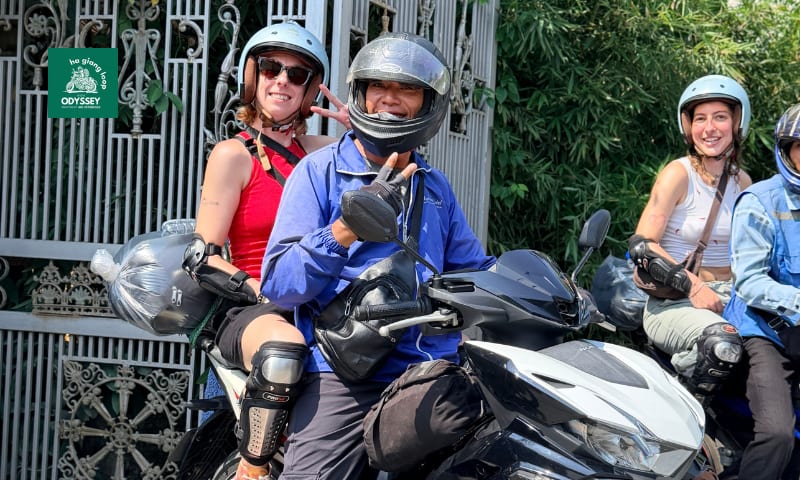
Easy Rider carrying a traveler through the Ha Giang mountains
What About a Guided Self-Ride Tour?
A guided self-ride can provide route support while allowing you to control your own motorcycle.
This may work for travelers who already have appropriate riding experience but do not want to manage:
Navigation.
Daily route planning.
Accommodation.
Major stops.
However, having a guide does not remove your responsibility for controlling the bike.
You still need the necessary skills and appropriate riding documentation.
Should Beginners Use a Scooter on the Ha Giang Loop?
Beginners should think carefully before using Ha Giang itself as a place to learn mountain riding.
Operating an automatic scooter may feel simple, but the Loop adds several challenges simultaneously:
Elevation.
Hairpins.
Long descents.
Unpredictable weather.
Changing road surfaces.
Traffic.
Multiple riding days.
The difficulty comes from the combination rather than any one element.
If you lack mountain-road experience, an Easy Rider can let you experience the same scenery without turning the trip into a riding lesson.
What Should You Check Before Renting a Scooter?
Before accepting the bike, inspect:
Tires.
Front brake.
Rear brake.
Lights.
Mirrors.
Suspension.
Horn.
Existing damage.
Ask the rental company about:
Damage policy.
Deposit.
Mechanical support.
Emergency contact.
Replacement bike procedure.
Also consider your luggage.
Heavy backpacks or poorly secured bags can affect handling.
Keep the load compact and properly secured.
Choose the Travel Format That Matches Your Experience
There is no need to choose self-riding simply because it appears more adventurous.
Different travelers enjoy Ha Giang in different ways.
You can compare Odyssey’s Ha Giang Loop journeys to see how different riding formats fit different levels of experience and preferred travel styles.
Self-riding can suit travelers who:
Have suitable mountain riding experience.
Hold appropriate documentation.
Understand the motorcycle they are using.
Are comfortable managing changing road conditions.
Easy Rider travel can suit those who:
Want the motorbike experience without controlling the bike.
Lack mountain experience.
Prefer more support.
Want to focus on the scenery. Comparing scooter semi-automatic and Easy Rider options for the Ha Giang Loop
So, Should You Do the Ha Giang Loop on a Scooter?
You can do the Ha Giang Loop on a scooter, but whether it is the right choice depends more on your experience than on whether the scooter can physically complete the route.
Automatic scooters are easy to operate, but Ha Giang adds conditions that many city riders rarely face.
These include:
Long mountain descents.
Tight hairpins.
Repeated elevation changes.
Wet roads.
Gravel.
Several hours of riding each day.
A semi-automatic motorcycle provides more direct gear control without requiring a hand clutch, while a manual motorcycle can suit riders who already use one confidently.
If your scooter experience includes mountain roads, steep climbs, long descents and changing surfaces, an automatic scooter may still be a realistic option.
If your experience is mainly urban riding, choosing an Easy Rider can let you enjoy the Loop without taking on riding responsibility.
The most important question is not simply:
“Can this scooter complete the Ha Giang Loop?”
It is:
“Can I control this scooter confidently through the full range of conditions the Ha Giang Loop may present?”
Experience the Nho Que river boat Ha Giang loop tour through Tu San Canyon. Complete guide to ticket prices, boat wharfs, motorbiking routes, and tips!
Discover the best viewpoints and ride timing for a Ma Pi Leng Pass Ha Giang Loop tour, including Sky Path, Nho Que River, weather, ride duration and Easy Rider options.
Visit Lung Cu Flag Tower Ha Giang Loop: Vietnam’s northernmost point with panoramic views. Get essential travel tips, motorbiking routes, and ticket info!